That is the short version. Here is what AI-native actually means, what it delivers on real shop floors, what it costs, and where shops keep getting it wrong.
What "AI-Native" Actually Means
For years, AI in machining meant a third-party box wired onto an existing machine. The data left the machine, got analyzed somewhere else, and came back as a report nobody read.
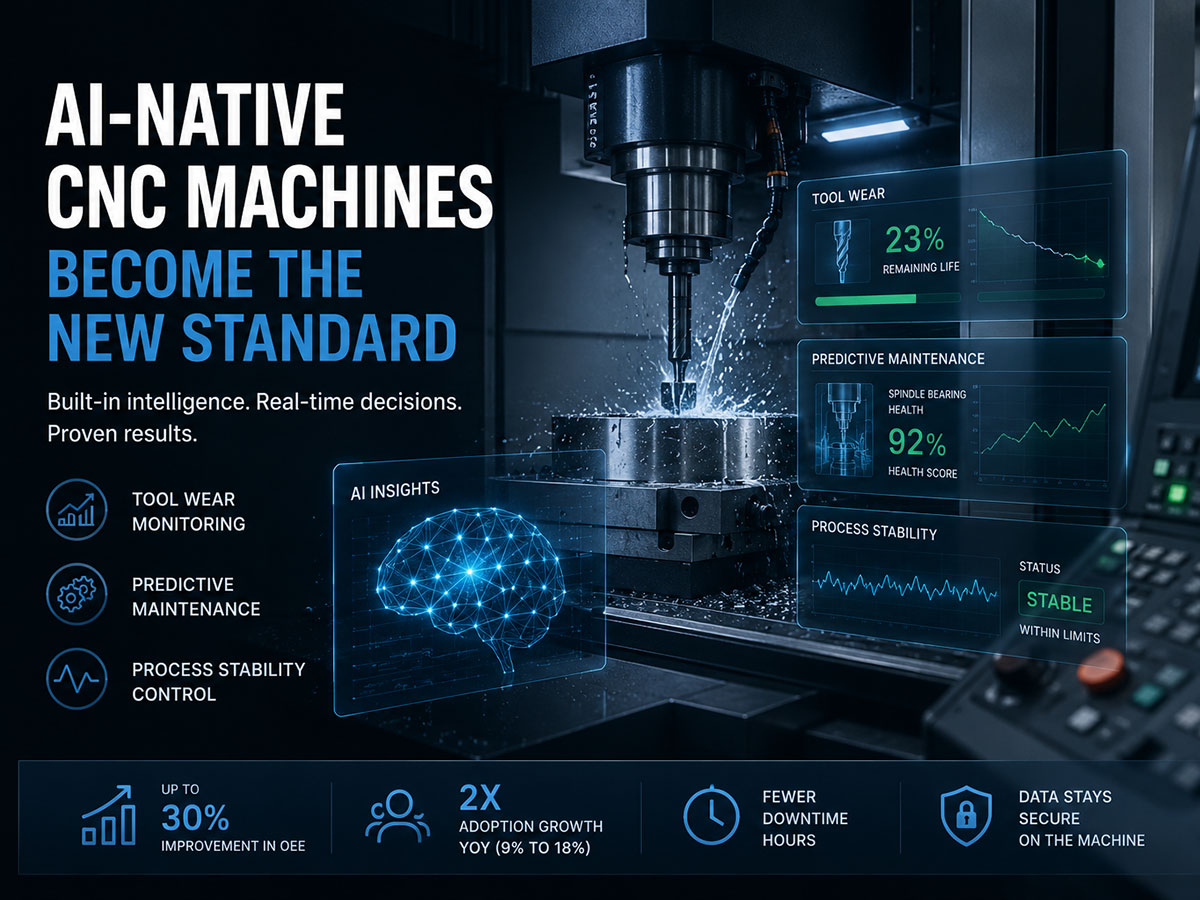
AI-native is different. The intelligence runs inside the machine control itself. Some CNC controls now ship with built-in vibration analytics channels, letting AI models run directly on board, filter out noise locally, and send only meaningful patterns onward.
That shift matters for 2 reasons. Decisions happen in milliseconds instead of overnight, and proprietary machining data stays protected instead of streaming raw to the cloud.
The 2026 Adoption Numbers
The data shows a technology crossing from pilot projects into standard practice:
• Predictive maintenance adoption doubled from 9 percent to 18 percent year on year (Fluke, May 2026).
• Reactive "fix it when it breaks" maintenance stayed flat at 36 percent of shops.
• Vendor-reported customer results include a 30 percent improvement in overall equipment effectiveness (IPercept, via MachineToolNews.ai).
• Workforce skills ranked as the top barrier to digital maturity in the same Fluke survey.
• Industry trend reports consistently name tool wear detection, predictive maintenance, and cutting-parameter recommendations as the 3 practical applications gaining traction.
One honest caveat that matters for trust: the strongest performance numbers in this market are vendor-reported customer results, not independent audits. Treat them as credible examples, not guaranteed outcomes for your shop.
The 3 Applications That Actually Work in 2026
Industry reporting is unusually aligned on this. Stecker Machine's 2026 trends analysis describes AI in machining as early-stage but gaining real traction in exactly 3 areas. Here is what each one does.
Szerszámkopás figyelése
AI models read spindle load, vibration, and cutting force signals to track how worn a tool actually is, instead of guessing from a fixed counter. The system recommends a tool change just before quality degrades or breakage becomes imminent.
The payoff is double. Shops stop scrapping parts cut with dead tools, and they stop throwing away tools with usable life left. Choosing quality CNC router bits and cutting tools remains the foundation; AI simply squeezes every hour of life from them.
Prediktív karbantartás
This is the application with the clearest money trail. AI learns the normal vibration, temperature, and current signature of components like spindle bearings, ball screws, and pumps. When the pattern drifts, the system flags developing wear, imbalance, or lubrication problems that manual inspection cannot see.
Fixed service intervals get replaced with data-driven alerts. Maintenance happens when the machine needs it, not when the calendar says so. The spindle is the sweet spot here, since spindle failure is among the most expensive unplanned events a shop can suffer. Even basic spindle care practices extend life; AI monitoring catches what routine checks miss.
Process Stability Control
The 3rd pillar watches the cut itself. AI monitors chatter, thermal drift, and load patterns during machining and adjusts feeds and speeds to keep the process inside its window.
For high-mix shops running new parts constantly, this tightens quality without requiring a veteran machinist to babysit every 1st article. It connects directly to the fundamentals covered in our overview of hogyan működik a CNC megmunkálás.
Comparing the 3 AI Applications
| Alkalmazás | Mérés | Érettség | Tipikus előny | Fő követelmény |
| Szerszámkopás figyelése | Scrap and tooling cost reduction | Proven, widely deployed | Fewer scrapped parts, longer tool life | Sensor data from spindle and axes |
| Előre látható karbantartás | Unplanned downtime hours avoided | Proven, fastest growing | Failures caught before breakdown | Baseline data period, alert ownership |
| Process stability control | First-pass yield improvement | Emerging, advancing quickly | Tighter tolerances in high-mix work | Modern control, parameter trust |
| Fully autonomous machining | Lights-out hours per week | Not yet standard | Limited to repeat, stable jobs | Years away for most shops |
The Measurement column is the practical filter. If you cannot name which number an AI feature will move, you are buying a demo, not a tool.
How AI-Native Systems Are Built
Every serious implementation follows the same 4-layer structure, whether it comes from the machine builder or a retrofit vendor:
• Adatgyűjtés: sensors on spindles, axes, and pumps capture vibration, temperature, load, servo current, and alarm history.
• Elemzés: machine learning models establish what normal looks like for each specific machine.
• Jóslás: the system forecasts which component is drifting toward failure and roughly when.
• Akció: alerts route to a person who schedules the fix before the breakdown.
That last layer is where projects live or die. The CloudNC analysis of predictive maintenance puts it bluntly: data does not reduce downtime by itself. A shop only gets value when the data changes decisions. The same principle applies to routine CNC gépek karbantartása: a checklist only works when someone owns it.
What It Costs, and Who Is Selling It
Machine builders are now packaging AI as standard equipment rather than an option. DMG Mori's CELOS X platform connects machines, scheduling, and analytics in one system, and most major builders ship comparable offerings on new machines.
For existing equipment, retrofit monitoring systems start at a few thousand dollars per machine for basic sensing and scale up with coverage. The hidden costs are not hardware. Budget for data infrastructure, integration time, and above all training, since the skills gap is the number one barrier shops report.
The smart starting point is narrow: pick the one machine that causes the most disruption when it stops, instrument that, and prove the value before scaling. Our breakdown of metal CNC machine costs shows how to model the full investment and payback.
How Shop Owners Are Actually Asking About This
These are the conversational questions circulating right now. If they sound familiar, you are the audience for this technology:
✓ "Is AI in CNC gépek real or is it the same condition monitoring with a new label?"
✓ "Can I add predictive maintenance to my ten-year-old machining center or only new machines?"
✓ "How many months of data does the AI need before its alerts mean anything?"
✓ "Who watches the alerts in a 5-person shop where everyone already has 2 jobs?"
✓ "Will the AI ever change my feeds and speeds without asking me first?"
✓ "What happens to my machining data, and can my machine builder see my customer parts?"
That last question is increasingly answered well. On-board analytics that process data locally and transmit only patterns, not raw part data, are becoming the standard architecture precisely because of it.
Common Mistakes When Adopting AI in Machining
These failures repeat across shops of every size. Check the list before signing anything:
• Connecting every machine on day one instead of starting with the most disruptive one.
• Buying the platform but assigning nobody to own the alerts.
• Expecting useful predictions before the system has a baseline learning period.
• Treating vendor-reported results as guaranteed outcomes for your shop.
• Ignoring the training budget when the skills gap is the documented top barrier.
• Choosing a closed system that locks your machine data into one vendor.
• Chasing autonomous machining headlines while skipping the proven basics.
• Measuring nothing before installation, which makes proving value impossible later.
Merre tovább ez
The near-term direction is convergence. Next-generation platforms are combining spindle analytics with tool condition monitoring, coolant flow data, and part-quality feedback into a single optimization loop.
The destination is a machine that does not just predict its own failures but continuously tunes the entire machining ecosystem. Nobody credible claims that is standard yet. The 2026 reality, confirmed across industry reporting, is early-stage technology delivering real but bounded wins: less scrap, fewer surprise breakdowns, tighter process windows.
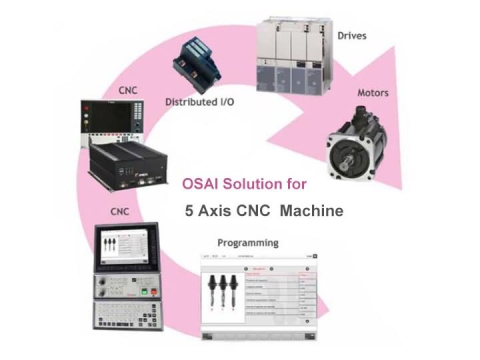
That is exactly why now is the rational moment to start. The shops building data baselines and alert habits today are the ones positioned to use the autonomous capabilities when they mature. For the bigger market context driving this investment, follow our CNC iparági hírek, and for the hardware side of the story, explore the 5-axis CNC machine lineup where AI-ready controls are increasingly standard.
Gyakran ismételt kérdések
What is an AI-native CNC machine?
A machine tool with artificial intelligence integrated directly into its control system rather than added through external software. The AI processes sensor data on board and acts in real time.
What are the proven uses of AI in CNC machining in 2026?
3 applications dominate: tool wear monitoring, predictive maintenance, and process stability control. Industry trend reports consistently identify these as the practical, traction-gaining uses while fully autonomous machining remains emerging.
How much does predictive maintenance reduce downtime?
Results vary by shop. Vendor-reported customer figures include up to 30 percent improvement in overall equipment effectiveness, but these are examples rather than guarantees. Independent results depend on data quality and alert follow-through.
Can older CNC machines use AI monitoring?
Yes. Retrofit sensor kits add vibration, temperature, and load monitoring to existing machines. Native integration on new machines is smoother, but age alone does not exclude a machine.
How fast is adoption growing?
Quickly from a small base. A May 2026 Fluke survey found predictive maintenance adoption doubled year on year from 9 percent to 18 percent, while 36 percent of operations still run reactive maintenance.
What is the biggest barrier to AI adoption in machine shops?
Workforce skills, according to the same 2026 survey data. The technology works, but someone must review the data, trust the alerts, and act on them.
Does AI replace machinists?
No. Current systems advise and alert rather than replace judgment. They remove guesswork from tool changes and maintenance timing, which makes experienced machinists more productive, not redundant.
What data do these systems monitor?
Typical signals include spindle load, vibration, temperature, servo current, cycle counts, and alarm history. Models learn each machine's normal signature and flag meaningful deviations.
Források és adatokkal kapcsolatos megjegyzések
Figures come from Fluke's May 2026 predictive maintenance adoption survey, MachineToolNews.ai 2026 reporting including the IPercept interview, Stecker Machine's 2026 CNC trends analysis, CloudNC's predictive maintenance research, and Amfas and Messer technical documentation, compiled in June 2026. Vendor-reported performance figures are identified as such throughout. Adoption data should be rechecked as new survey waves publish.
Build Your Shop on a Modern Foundation
AI monitoring delivers the most on capable, well-maintained machines. Explore STYLECNC CNC megmunkáló központok és a fém CNC gépek with modern SYNTEC and OSAI controls, ready for the data-driven shop floor.